

Best Wireless Microphones for Solo Filming in 2026
Table of Contents
- Why Solo Filming Demands a Different Microphone
- Quick Comparison: Wireless Microphones for Solo Filming
- BOYA BY-BM6060: Best for Camera-Mounted Solo Filming
- SYNCO Lav-S6E: Best Wired Lavalier for Solo Filming on a Budget
- ALLOET 2-in-1 Wireless System: Best for Hands-Free Solo Filming and Vlogging
- Choosing a Wireless Microphone for iPhone Video and Mobile Recording
- Wireless Microphone Range for Video: How Far Can You Actually Go?
- How to Record Audio While Filming Alone: A Solo Workflow
- Frequently Asked Questions
Last Updated: October 13, 2026
Why Solo Filming Demands a Different Microphone
Solo filming is the practice of recording video content alone, handling your own camera, framing, and audio without a crew. That single fact changes what a microphone has to do. A two-person crew can run a boom pole, adjust levels mid-take, and swap a dead battery while the camera rolls. You cannot.
Most guides on the best wireless microphones for solo filming rank gear by specs alone. That misses the point. The microphone that wins a studio shootdown is often the wrong one when you are setting up, framing, and performing by yourself.
Solo filming is different because every piece of gear has to survive being operated by the person on camera. That means fast setup, simple pairing, and a mounting system that works with the camera you already own. The picks below are grouped by how they actually get used: camera-mounted, wired lavalier, and hands-free wireless.
Quick Comparison: Wireless Microphones for Solo Filming
| Microphone | Price | Type | Power | Best For |
|---|---|---|---|---|
| BOYA BY-BM6060 | $271.99 | Shotgun condenser, XLR | 24-48V phantom or 1x AA | Camera-mounted solo filming |
| SYNCO Lav-S6E | $46.99 | Wired lavalier, 3.5mm TRRS/TRS | Wired, no battery | Budget solo filming |
| ALLOET 2-in-1 | $36.99 | 2.4G wireless headset/handheld | Rechargeable | Hands-free vlogging |
| Alctron Windscreen 5-Pack | $28.99 | Accessory | None | Wind and pop protection |
BOYA BY-BM6060: Best for Camera-Mounted Solo Filming
The BOYA BY-BM6060 is a super-cardioid shotgun condenser microphone built for video production and broadcast audio, and it is the strongest pick here for solo filming on a camera. Its super-cardioid polar pattern focuses pickup on your subject while resisting circuit noise, so a single person talking to a locked-off camera lands cleanly in the mix.

Mounting is the part that matters most when you work alone. The BY-BM6060 ships with a shock mount, a furry windscreen, a foam windscreen, and a cold-shoe mount with a 1/4-inch thread, so it attaches straight to a DSLR or a stand without extra parts. Power is flexible too: a 3-pin XLR output runs on 24-48V phantom power, or you can drop in a single AA battery when phantom power is not available.
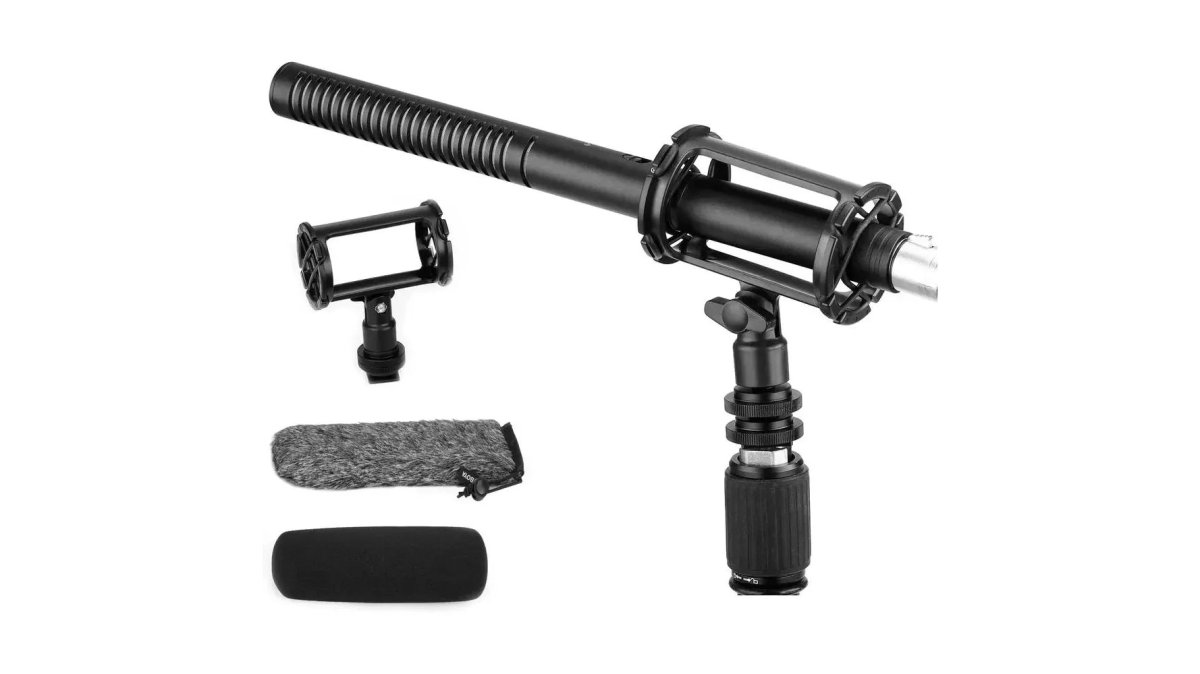
Performance in Challenging Audio Environments
Outdoor shoots are where cheap microphones fall apart. Wind, traffic, and room reflections all hit a shotgun mic at once, and the BY-BM6060 handles the first of those through its included furry windscreen, which is the correct tool for wind rather than the foam cover most kits ship with. The low-noise circuitry keeps the noise floor down when you push gain on a quiet subject.
The honest limitation: a shotgun mic is directional. If you turn your head away from the camera, the level drops. For a solo presenter who stays roughly on-axis, that is fine. For someone who paces and gestures, a lavalier is the better tool, which is exactly why the next pick exists.
SYNCO Lav-S6E: Best Wired Lavalier for Solo Filming on a Budget
The SYNCO Lav-S6E is a wired omnidirectional lavalier microphone with a 6-meter cable, and it is the best value pick for solo filming when the budget is tight. At $46.99 it costs a fraction of a wireless system, and because it is wired, there is no battery to charge and no signal to drop.

The 6-meter cable gives real reach for interviews, lessons, and vlogs, and automatic pairing with 3.5mm TRRS and TRS inputs means it connects to iOS and Android phones, cameras, laptops, and PCs without an adapter. That matters for solo work: fewer adapters means fewer things to lose and fewer points of failure when you are the only person on set. A 360-degree condenser capsule captures natural detail, and low self-noise circuitry rolls off ambient noise below 70Hz for a cleaner voice track.
The tradeoff is obvious. A cable limits how far you can move, and it can snag on a chair or a door handle mid-take. For a seated or stationary solo shoot, that is a fair trade for the price.
ALLOET 2-in-1 Wireless System: Best for Hands-Free Solo Filming and Vlogging
The ALLOET 2-in-1 is a 2.4G wireless microphone system that combines a headset and a handheld mic in one design, with a detachable headband. For solo filming where your hands are busy, this is the pick. It is the cheapest wireless option here at $36.99, and it solves the one problem a wired lavalier cannot: freedom of movement.

The headset mode is the standout for solo creators. Clip it on, detach the headband if you prefer, and you can talk, demonstrate, cook, or work out while your hands stay free and your audio stays consistent. Long-range, interference-free transmission lets multiple units run at once without frequency adjustments, and automatic pairing on power-up keeps setup to seconds.
Where it falls short: this is a voice-first system, not a cinematic one. It is built for clarity on speech, not for capturing room tone or music. If your solo content is talking-head or instructional, that is exactly right.
Choosing a Wireless Microphone for iPhone Video and Mobile Recording
Mobile recording changes the connector question entirely. A wireless microphone for iPhone video needs to match the port on the phone, and that requirement has shifted in recent years as Apple moved its phones to USB-C. Older iPhones still use Lightning, so the same microphone can need two different cables depending on which phone you own.
The practical approach is to buy a system with a swappable or universal output rather than one locked to a single connector. The SYNCO Lav-S6E sidesteps the problem by pairing automatically with 3.5mm TRRS and TRS inputs, which covers phones, cameras, laptops, and PCs without an adapter. The ALLOET system ships with an adapter in the box, which covers the same ground wirelessly.
BOYA BY-BM6060 Shotgun Condenser Microphone →
Before you buy, check three things: the port on your phone, whether the microphone ships with the matching cable, and whether it also works with your camera. A microphone that covers both your phone and your camera is worth more than one that covers only a single device, because solo creators rarely shoot on just one.
Wireless Microphone Range for Video: How Far Can You Actually Go?
Wireless microphone range for video is the distance between transmitter and receiver before the signal drops, and the honest answer is that real-world range is always shorter than the spec sheet. Manufacturers quote line-of-sight figures, and line-of-sight is rarely what you get in a room with walls, furniture, and other people.
Three factors cut your usable range:
- Obstacles. Walls, doors, and even a human body between transmitter and receiver weaken the signal.
- Interference. Wi-Fi networks, Bluetooth devices, and other wireless gear share the same airspace.
- Battery and power. A weak or dying battery can shorten reliable range before the system cuts out entirely.
The ALLOET system uses 2.4G transmission, which is designed to resist interference and let multiple units run at once without frequency adjustments. That is a real advantage in crowded spaces. Still, the only range number that matters is the one you test yourself. Walk your actual filming distance, hit record, and listen back before the shoot.
How to Record Audio While Filming Alone: A Solo Workflow
Learning how to record audio while filming alone comes down to a repeatable order of operations. The goal is to make setup boring, so your attention goes to the performance instead of the gear.
Total Time: 10-15 minutes for a first setup, 3-5 minutes once it is routine.
- Set the microphone first. Mount it, power it, and confirm the connection light before you touch the camera. Audio problems are cheaper to fix before you frame the shot.
- Check the connector. Match the output to your device and confirm the cable is fully seated. A half-inserted plug is the most common cause of a silent track.
- Test your distance. Walk to the farthest point you plan to move and record ten seconds. Listen back with headphones.
- Set levels with headroom. Aim for peaks that leave room to spare rather than pushing the meter into the red.
- Record a backup. Run a second audio source if you have one, even a phone in your pocket, so a single failure does not kill the take.
- Clap once before the take. A single sharp clap gives you a visual and audio sync point in editing.
- Monitor as you go. Check levels mid-take rather than discovering a problem in the edit.
Monitoring and Backup Recording Tips
Audio monitoring is the step solo creators skip, and it is the one that saves takes. If your setup allows it, listen through headphones while you record so you catch a dropout or a rustle in real time rather than after the shoot.
Backup recording is the second habit worth building. Running a second source costs nothing and protects you from a dead battery, a loose cable, or a signal drop. The SYNCO Lav-S6E is a natural backup to a wireless system because it needs no power at all, so it keeps working when a battery does not.
Wind protection deserves a place in the routine too. The Alctron foam windscreen 5-pack fits most handheld wired and wireless microphones, reduces wind and pop noise, and protects the capsule from dust.
Solo filming leaves no room for gear that needs a second operator, and the wrong microphone will cost you takes you cannot reshoot.
Frequently Asked Questions
What is the best wireless microphone for solo filming?
The best choice depends on your camera and budget. For camera-mounted solo filming, the BOYA BY-BM6060 shotgun condenser microphone offers focused pickup and a cold-shoe mount. If you film with a smartphone and want hands-free operation, the ALLOET 2-in-1 wireless system pairs automatically and includes a headset option. For a low-cost wired alternative, the SYNCO Lav-S6E lavalier works with phones and cameras via 3.5mm.
Are wireless microphones good for filming videos?
Yes, wireless microphones give solo creators freedom of movement and clean audio without cables running to the camera. The key is matching the transmitter and receiver to your recording device. Systems like the ALLOET 2-in-1 use 2.4G transmission and automatic pairing, which simplifies setup. For solo filming, wireless range and battery life matter more than having multiple transmitters.
What should I look for in a wireless microphone for solo filming?
Focus on four things: compatibility with your phone or camera, wireless range, battery life, and how you will monitor audio. For solo filming, a plug-and-play system with automatic pairing saves time. Check whether the receiver connects via USB-C, Lightning, or 3.5mm. Also consider whether the microphone includes windscreens for outdoor shooting, since wind noise ruins more solo takes than distance does.
Is a lavalier or a shotgun microphone better for filming alone?
A lavalier like the SYNCO Lav-S6E clips to your clothing and keeps your hands free, which suits talking-head videos and vlogs. A shotgun like the BOYA BY-BM6060 mounts on the camera and picks up audio from a focused direction, which works better when you are behind the camera or filming a subject. For solo filming, lavaliers are easier to manage alone because you do not need to aim the mic.
How far can a wireless microphone transmit audio?
Range varies by system. The ALLOET 2-in-1 wireless microphone uses 2.4G transmission and supports long-range, interference-free operation, though walls and crowded Wi-Fi environments reduce usable distance. For solo filming, you rarely need more than 10 to 15 meters unless you are filming wide shots. Always test your wireless microphone range for video in the actual location before a shoot.