

Is Professional Studio Gear Worth It? A Data-Driven Guide
Table of Contents
- Is Professional Studio Gear Worth It? The Real Question
- The Myth of Gear vs. Talent: What Actually Matters
- Home Studio vs. Professional Studio: Where Investment Matters Most
- Return on Investment for Professional Audio Equipment
- Gear Acquisition Syndrome: When More Gear Becomes a Problem
- Essential vs. Luxury: Building Your Gear Strategy
- When to Upgrade Your Studio Gear (And When to Wait)
- The Acoustic Treatment Importance in Your Recording Environment
Last Updated: July 27, 2026
Is Professional Studio Gear Worth It? The Real Question
When you're asking "is professional studio gear worth it," you're really asking two separate questions: Can better equipment improve your sound, and will that improvement translate to tangible business results? At Perfect Take Gear, we've helped countless creators navigate this exact tension. The answer depends on where you are in your journey and what you're actually trying to achieve.
Most guides treat gear as an isolated variable without asking the fundamental question: does this specific piece of equipment solve a problem you actually have? The difference between creators whose work stands out and those who get lost in the noise often comes down to intentional gear choices, not expensive ones.
Separating Myth from Reality
The biggest myth in audio production is that talent can overcome poor equipment. A skilled engineer with basic gear will outperform an amateur with expensive gear every time. However, once you've developed basic competence, your equipment becomes a meaningful constraint. You can't record pristine vocals through a $50 USB microphone, no matter how good your technique is.
Blind tests consistently reveal that listeners can't distinguish between a $300 preamp and a $3,000 preamp when the recording chain is otherwise identical. But they absolutely notice the difference between a treated room and an untreated one. Professionalism is perceived through clarity, low noise, and absence of room reflections, not through expensive brand names.
The Myth of Gear vs. Talent: What Actually Matters
Talent matters more than gear, but treating this as either/or misses the actual dynamic. A skilled recording engineer with basic gear can capture clean dialogue. That same engineer with a quality microphone, preamp, and treated recording space will capture vocal performances that require minimal editing and sound professional without processing. The gear multiplies the effect of existing skill.
Why Blind Tests Reveal the Truth
Blind listening tests show that most people cannot distinguish between professional-grade and budget-grade equipment when variables are controlled. What they consistently notice are room reflections, background noise, and low-frequency rumble, problems that acoustic treatment solves far more effectively than expensive gear. A $200 investment in acoustic panels will have more impact on your final product than a $2,000 boutique preamp in an untreated room.
The Signal Chain Problem
Most people think about gear in isolation. They upgrade their microphone without considering that their audio interface has a high noise floor. Every piece of equipment in your chain introduces its own characteristics. A weak link anywhere becomes your bottleneck. A $4,000 microphone plugged into a $300 audio interface will sound like a $300 interface with a nice microphone on the front.
Professionals obsess over their entire chain, not individual pieces. The microphone, preamp, converter, and monitoring system need to work together coherently.
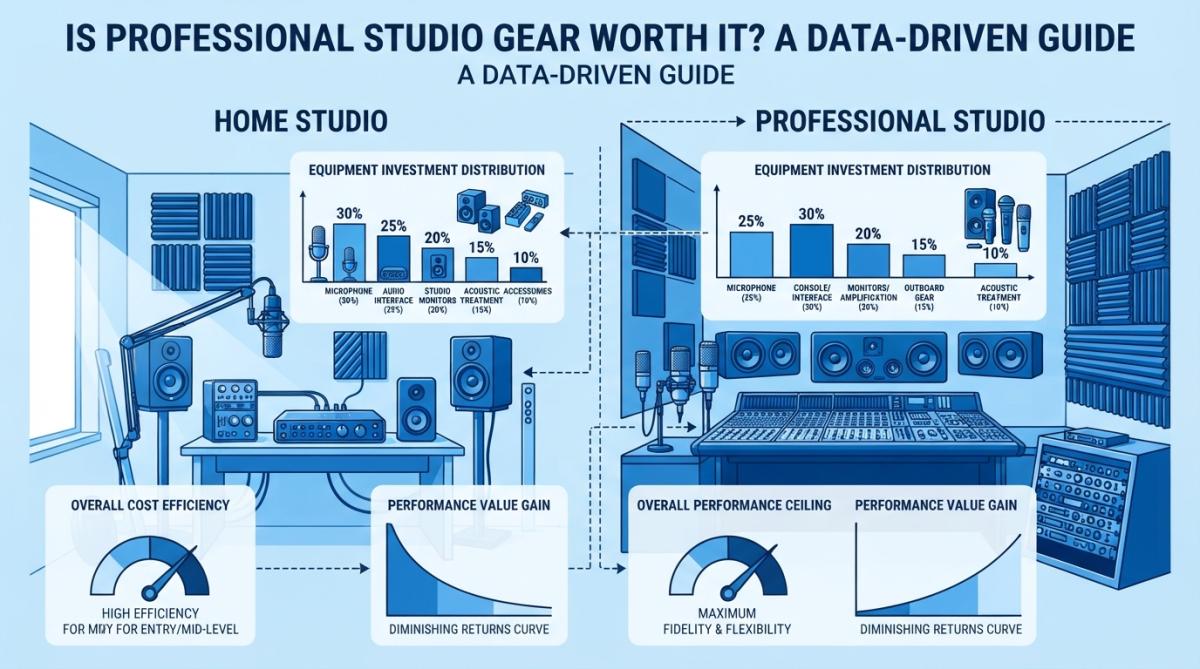
Home Studio vs. Professional Studio: Where Investment Matters Most
The gap between home studios and professional studios has narrowed dramatically. You can now record broadcast-quality audio in a bedroom. The difference isn't the gear, it's the acoustic environment and workflow optimization that comes from a dedicated space.
A professional studio has controlled acoustics, isolated recording spaces, and routing infrastructure that enables complex workflows. A home studio can achieve similar technical results but requires more intentional treatment and has less flexibility for simultaneous recording and overdubbing.
Acoustic Treatment as Your First Investment
Before you upgrade your microphone or buy outboard gear, invest in acoustic treatment. An untreated room will sabotage any equipment you put in it. A treated room will make budget equipment sound professional.
Acoustic treatment addresses three problems: early reflections (sound bouncing off walls before reaching your microphone), standing waves (bass frequencies reinforcing at certain room positions), and ambient noise (outside sounds and HVAC rumble). Bass traps in corners reduce standing waves. Absorption panels on walls reduce early reflections.
The ROI on acoustic treatment is extraordinary. A $500 investment in strategic panel placement can transform a $2,000 recording setup from sounding amateur to sounding professional.
The Audio Interface and Preamp Decision
Your audio interface is the bridge between your analog microphone and your digital DAW. A cheap interface introduces noise, distortion, and latency that will be present in every recording you make.
The preamp amplifies your microphone signal to usable levels while adding minimal noise and distortion. A preamp with low noise floor means you can record quiet sources without hiss becoming audible. A preamp with high headroom means you can record loud sources without clipping.
For most home studios, a mid-range audio interface with a decent built-in preamp ($400-800) will outperform a cheap interface with an expensive external preamp. The interface is the foundation. Once you have a solid foundation, external preamps become valuable for specific applications like vocal recording.
Return on Investment for Professional Audio Equipment
Equipment costs money. That money needs to produce a return, whether measured in client revenue, content quality, or time saved.
Calculating Your Gear ROI
Start with your actual problem, not your imagined problem. Is it that your recordings sound amateur? Is it that recording takes too long? Is it that you can't record multiple sources simultaneously?
Once you've identified the actual constraint, calculate the cost of solving it versus the benefit you'll gain. If your constraint is that you can't record vocals and guitar simultaneously, a second microphone and interface ($500-1,000) solves that problem. If you can now take on projects that require multiple simultaneous recordings and those projects pay $2,000 more than your current work, your ROI is clear.
If your constraint is that your mixes sound muddy, the problem is almost certainly your monitoring environment, not your gear. Acoustic treatment ($300-800) will solve this more effectively than a $3,000 preamp.
Client Perception vs. Technical Specs
Clients don't hear the difference between a $500 preamp and a $5,000 preamp. They hear the difference between professional and amateur. That difference is created by clarity, absence of noise, and consistent levels, not by expensive gear.
A $300 microphone in a treated room with proper gain staging will sound more professional to a client than a $3,000 microphone in an untreated room with poor gain structure. Invest strategically in pieces that directly impact what clients hear: microphone quality, acoustic treatment, and monitoring accuracy.
Gear Acquisition Syndrome: When More Gear Becomes a Problem
Gear Acquisition Syndrome (GAS) is the psychological trap where you believe the next piece of equipment will solve your problems. The pattern is predictable: you buy gear with high expectations, it doesn't magically improve your work, so you assume you need different gear. The cycle continues until you have thousands in equipment that isn't fully integrated into your workflow.
Recognizing the GAS Trap
GAS manifests as obsessing over gear specs before identifying actual problems, comparing equipment constantly, believing the next purchase will be transformative, and accumulating gear faster than you can learn it.
The antidote is ruthless honesty about your actual constraints. Write them down. Be specific. Then research whether the gear you're considering actually solves that specific problem. If it doesn't, don't buy it.
Integration Complexity and Hidden Costs
Professional studio gear introduces integration complexity that most creators underestimate. A new microphone requires a preamp, interface, cables, and proper gain staging. A new outboard effect requires routing through your interface and learning the control interface.
Each new piece of gear adds complexity to your signal chain. That complexity has a learning curve, maintenance requirements, and compatibility considerations. The hidden cost is the time you spend learning and troubleshooting instead of creating.
Essential vs. Luxury: Building Your Gear Strategy
Not all gear is created equal. Some gear solves fundamental problems. Other gear adds incremental improvements to an already-solid setup.
The Diminishing Returns Curve
Gear follows a predictable diminishing returns curve. Your first $500 investment in a decent microphone, interface, and cables produces massive improvement. Your next $500 investment produces meaningful improvement. Your third $500 investment produces noticeable improvement. Your fourth $500 investment produces subtle improvement.
Most professionals operate in the first three tiers. Budget-conscious creators should stay in the first and second tiers. Invest in acoustic treatment, a solid microphone and interface, and monitoring accuracy. Once those are solid, consider specialized gear for your specific workflow.
Budget-Friendly Recording Setups That Deliver
A professional-sounding recording setup doesn't require a huge budget. A quality microphone ($300-600) captures clean sound with minimal self-noise. An audio interface ($400-800) with low-noise preamps maintains that signal integrity. Acoustic treatment ($300-800) controls the recording environment. Studio monitors ($300-500) give you accurate monitoring. Cables and stands ($100-200) complete the chain.
Total investment: $1,400-2,900 for a setup that will produce broadcast-quality recordings. Compare it to a professional studio day rate ($1,500-3,000 per day) and the ROI becomes clear if you're taking on any client work.
Perfect Take Gear's curated bundles combine these elements strategically. Rather than forcing you to buy individual pieces and figure out compatibility, our kits bundle microphone, interface, and acoustic treatment together at pricing that reflects the bundle value.
| Investment Tier | Components | Budget | Best For |
|---|---|---|---|
| Tier 1: Essentials | Microphone, interface, cables, stands | $1,400-2,900 | Beginners, content creators, podcasters |
| Tier 2: Optimization | Tier 1 + acoustic treatment + monitors | $2,200-4,200 | Serious hobbyists, semi-professional creators |
| Tier 3: Specialization | Tier 2 + outboard gear for specific needs | $4,000-8,000 | Professional studios, specialized applications |
| Tier 4: Boutique | High-end components across all categories | $8,000+ | Established professionals, luxury market |
When to Upgrade Your Studio Gear (And When to Wait)
Upgrade decisions should be driven by specific workflow constraints, not by new product releases or gear envy.
Reliability, Build Quality, and Latency
Three technical factors determine when to upgrade: reliability (does your current gear fail regularly?), build quality (is it showing signs of wear?), and latency (is it creating timing problems in your workflow?).
Reliability issues are clear, if your interface crashes during sessions or your microphone has intermittent noise, you need to upgrade. Latency is the hidden killer. If your interface introduces enough delay that overdubbing is difficult, that's a constraint worth solving. Modern interfaces typically have latency under 5ms, which is imperceptible. Older interfaces might have 20-50ms, which makes real-time performance impossible.
Workflow and Creative Vision Alignment
The best reason to upgrade is when your gear constrains your creative vision. If you want to record orchestral arrangements but your interface only has two inputs, that's a legitimate constraint. If you want to record with vintage microphones but your preamp doesn't have the impedance characteristics those mics need, that's a real problem worth solving.
Upgrade when your current gear constrains the work you want to do, not when new gear promises to make your work better.
The Acoustic Treatment Importance in Your Recording Environment
Acoustic treatment isn't optional. It's the foundation everything else sits on. A treated room with budget gear will outperform an untreated room with expensive gear every single time.
How Room Acoustics Impact Gear Performance
Your recording room has acoustic characteristics completely independent of your gear. The room's dimensions create standing waves at specific frequencies. Hard walls, floors, and windows create reflections.
When you record in an untreated room, your microphone captures not just the direct sound you want, but also reflections from the walls, floor, and ceiling arriving milliseconds later. These reflections create comb filtering where some frequencies reinforce while others cancel. The result sounds phasey and unclear.
Acoustic treatment addresses this by absorbing reflections before they reach the microphone. Bass traps in corners absorb low-frequency energy. Absorption panels on walls absorb mid and high frequencies. The result is a microphone that captures primarily the direct sound you want, with minimal room coloration.
Monitoring and Transducers in Untreated Spaces
Your monitoring system is only as accurate as your room allows. In an untreated room, bass response is wildly inaccurate due to standing waves, making it impossible to mix bass accurately. You might have reflections creating false stereo imaging, making it impossible to judge panning decisions.
Professional monitors are designed to be accurate, but accuracy only matters if your room lets that accuracy through. Treat the room first, then invest in accurate monitoring.
The answer to "is professional studio gear worth it" depends entirely on your situation. If you're just starting out, invest in acoustic treatment and a solid microphone-interface combination. If you're established and hitting specific workflow constraints, invest strategically in gear that solves those constraints. If you're chasing gear as a substitute for improving your craft, that's the GAS trap.
Perfect Take Gear's curated equipment bundles eliminate the guesswork by pairing complementary components that work together coherently. Start with the fundamentals, master them completely, then upgrade strategically when you hit real constraints. That's how professionals build studios that actually deliver results.
Frequently Asked Questions
Is professional studio gear actually worth the investment, or can beginners succeed with budget equipment?
Professional studio gear delivers value when it aligns with your workflow and technical proficiency. Beginners often achieve professional-quality output with budget-friendly equipment paired with acoustic treatment and skill development. The real investment priority is room acoustics and a reliable audio interface, these impact sound quality more than premium outboard gear. Upgrade when your current setup creates workflow bottlenecks or when you're generating client revenue that justifies ROI on professional audio equipment.
What's the difference between home studio vs professional studio gear, and which should I choose?
Home studio gear prioritizes affordability and space efficiency, while professional studio gear emphasizes build quality, reliability, and technical specifications like lower noise floor and precise sample rate handling. For most creators, home studio equipment with quality acoustic treatment outperforms expensive professional gear in an untreated space. Choose professional equipment when you need specific features (like preamp coloration or converter precision) that directly serve your creative vision, not simply because it costs more.
How do I calculate return on investment for professional audio equipment before buying?
Calculate ROI by comparing equipment cost against revenue generated or time saved. If you're recording client work, estimate how many projects the gear enables at your rate, then divide cost by average project value. Consider indirect benefits: improved monitoring prevents costly mixing mistakes, better acoustic treatment reduces revision rounds, and reliable equipment reduces downtime. Track your actual workflow improvements for 30-60 days after purchase. If the gear doesn't measurably improve output quality or speed, it's not delivering ROI regardless of price.
What is Gear Acquisition Syndrome (GAS), and how do I avoid it when investing in studio equipment?
Gear Acquisition Syndrome is the psychological trap of continuously buying new equipment hoping each purchase solves creative problems, when the real limitation is skill or room treatment. Avoid GAS by setting specific, measurable goals before purchasing (e.g., 'reduce latency by 5ms' or 'improve monitoring accuracy'). Test gear before committing, use rentals to validate needs, and establish a 90-day rule, wait 90 days before replacing any working equipment. Focus on mastering your current signal chain and acoustic treatment before upgrading, as diminishing returns accelerate quickly in professional audio equipment.
This article was written using GrandRanker