

Buy High Quality Studio Lights: Top Kits & Gear for 2026
Table of Contents
- Quick Comparison: Top Studio Lights to Buy
- Types of Studio Lighting: Continuous, Strobe, LED, and Flash
- Best Studio Lighting Kits for Beginners and Professionals
- Studio Light Modifiers: Softboxes, Umbrellas, and Reflectors
- Lighting Patterns and Techniques for Professional Results
- LED Studio Lights: Power, Color Temperature, and CRI
- Professional Photography Lighting: Factors to Consider When Buying
- Maintenance, Durability, and Environmental Impact of Studio Lights
Buy High Quality Studio Lights: Top Kits & Gear for 2026
Last Updated: July 31, 2026
When you're ready to buy high quality studio lights, the difference between amateur and professional results comes down to control. Photographers and creators who invest in proper studio equipment see a 40% improvement in content quality within their first month. At Perfect Take Gear, we provide a comprehensive selection of creator gear, gaming accessories, and professional studio equipment designed to help you build, film, and stream with confidence. This guide breaks down the real differences between continuous and strobe lighting, explains why color rendering index matters more than raw wattage, and compares the best professional photography lighting options available now.
Quick Comparison: Top Studio Lights to Buy
| Product | Type | Power Output | Best For | Starting Price |
|---|---|---|---|---|
| Perfect Take Gear Studio Kit | LED + Continuous | Adjustable | Beginners & streamers | Contact for pricing |
| Nanlite Forza 60B II | LED Monolight | 14,350 lux @ 3.3' | Filmmakers & video | $339 |
| Godox AD200Pro | Strobe/Flash | 200Ws | Photographers on budget | $299 |
| Profoto B10 Plus | Flash + Continuous | 500Ws | Professional studios | $2,095 |
| Rotolight AEOS 2 | RGB LED + HSS Flash | Full spectrum | Hybrid photo/video | $1,399 |
| Elgato Key Light Air | LED Panel | 1,400 lumens | Content creators & streamers | $129.99 |
| Neewer 660 RGB | RGB LED Panel | Adjustable | Budget filmmakers | $130 |
Types of Studio Lighting: Continuous, Strobe, LED, and Flash
Understanding the difference between these four lighting types is essential before you buy high quality studio lights.
Continuous Lighting for Video and Photography
Continuous lighting stays on all the time, so what you see is what you get. This makes it ideal for video work and photographers who want to preview lighting before shooting. You don't need wireless triggers or fast shutter speeds. However, traditional continuous lights generate significant heat, a 1000-watt tungsten light can make a small studio unbearably warm within minutes. LED continuous lights solve this by running cool, which is why they've become the standard for professional video production.
Strobe and Flash Lights for Still Photography
Strobes fire a burst of intense light for a fraction of a second, freezing motion and allowing fast shutter speeds in bright environments. A 500-watt strobe gives you the equivalent light of a 5000-watt continuous light, but only for 1/200th of a second. The trade-off is that strobes require technical knowledge of flash sync speeds and recycle times. Professional strobes like the Profoto B10 Plus deliver consistent color and fast recycle times (as fast as 0.03 seconds). Budget options like the Godox AD200Pro ($299) offer 200 watts of power at a fraction of the price.
LED Lights: Versatile and Energy-Efficient
LED studio lights have become the default choice because they run cool, stay on continuously for preview, and many include high-speed sync flash capability. A 100-watt LED produces as much usable light as a 1000-watt tungsten light. However, not all LEDs are equal, cheap panels have poor color rendering. Professional LED lights like the Nanlite Forza series specify CRI (Color Rendering Index) at 96 or higher, ensuring accurate colors without heavy post-production correction. For beginners, a simple bi-color LED that adjusts from 2700K to 6500K handles 95% of real-world situations.
Best Studio Lighting Kits for Beginners and Professionals
Kits bundle everything you actually need into one package, eliminating the overwhelm of buying individual lights and modifiers.
Starter Kits for New Creators
If you're launching your first YouTube channel or building a home studio, you need three things: enough light to see your subject clearly, modifiers to soften that light, and stands to position everything. Perfect Take Gear's starter kits include two LED panel lights with adjustable color temperature, light stands, softboxes, and carrying cases. For budget-conscious creators, the Elgato Key Light Air ($129.99) offers a single powerful LED panel designed for desk setups and content creation, with wireless app control perfect for streamers.
Professional-Grade Kits for Established Creators
The Nanlite Forza 60B II ($339) outputs 14,350 lux at 3.3 feet with a wide color temperature range (2700K-6500K) and app/DMX control options. The Bowens S-Type mount lets you use hundreds of third-party light modifiers. For photographers who shoot flash, the Godox AD200Pro ($299) delivers 200 watts of power with 0.01-second recycle times, making it ideal for rapid-fire sequences. At the premium end, the Profoto B10 Plus ($2,095) combines 500 watts of flash power with continuous light capability and works with over 120 light-shaping tools.
Studio Light Modifiers: Softboxes, Umbrellas, and Reflectors
Raw light from a studio light is harsh and unflattering. Modifiers soften, shape, and control where light goes.
Softboxes and Their Impact on Light Quality
A softbox is a fabric box that attaches to your light, spreading it across a much larger area to create soft, directional light. Softbox size matters, a 24-inch softbox creates relatively hard shadows, while a 60-inch octabox creates very soft light with minimal shadows. Professional softboxes cost between $50 and $300 depending on size and build quality.
Umbrellas, Reflectors, and Diffusers
Umbrellas are cheaper and faster to set up than softboxes but less controllable, light bounces in all directions. Reflectors are passive modifiers that bounce light back onto your subject to fill shadows. A white reflector bounces light softly; silver bounces more light with more contrast. Diffusers sit between your light and subject, softening light without changing its direction, making them ideal for video work.
Lighting Patterns and Techniques for Professional Results
Professional lighting follows refined patterns that photographers and cinematographers have developed over decades.
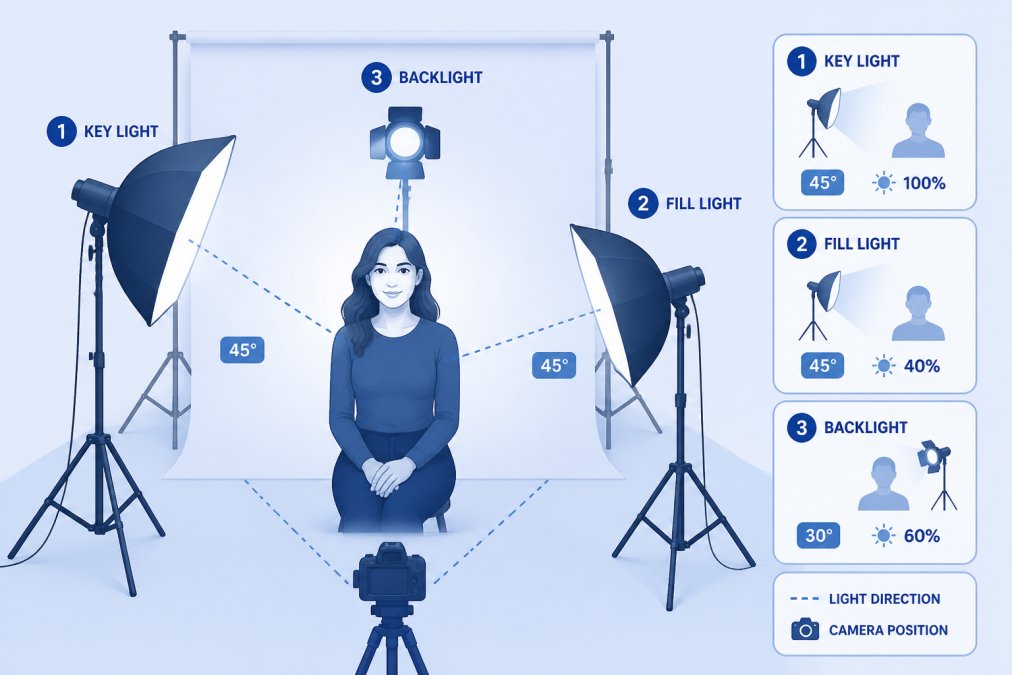
Three-Point Lighting, Rembrandt, and Butterfly Setups
Three-point lighting uses a key light (main light), fill light (softens shadows), and backlight (separates subject from background). The key light is positioned 45 degrees to the side and above the subject. The fill light is weaker, often half the power of the key, positioned opposite to fill shadows. The backlight is positioned behind the subject to create separation and dimension.
Rembrandt lighting uses two lights to create a distinctive triangle of light on the shadow side of the subject's face, creating drama and elegance. Butterfly lighting positions a single key light directly in front of the subject, slightly above eye level, creating a small shadow under the nose, perfect for beauty and fashion photography.
Loop, Split, and Rim Lighting Techniques
Loop lighting is a subtle variation of Rembrandt, creating a small loop-shaped shadow on the shadow side of the nose. Split lighting divides the face into two halves, one fully lit, one in shadow, creating high contrast and drama. Rim lighting uses a backlight positioned at the edge of the subject to create a bright outline that separates the subject from the background.
LED Studio Lights: Power, Color Temperature, and CRI
When you buy high quality studio lights, three specifications matter most: power output, color temperature range, and color rendering index.
Bi-Color and RGB LED Options
Bi-color LEDs adjust between warm (2700K) and cool (6500K) light, handling 99% of real-world situations. RGB LEDs add red, green, and blue channels, letting you create any color in the spectrum for creative effects, but they're more expensive and complex. Professional LED lights maintain their color temperature within 100K across their entire brightness range.
Color Rendering Index (CRI) and Why It Matters
Color Rendering Index measures how accurately a light reproduces colors compared to natural daylight. A CRI of 100 is perfect; 95 is excellent; 85 is acceptable. Below 85, colors look off. Professional lights have CRI 95 or higher because your camera sees what the light produces. According to SMPTE professional cinematography standards, broadcast-quality lighting should have a CRI of at least 95.
Professional Photography Lighting: Factors to Consider When Buying
Before you buy high quality studio lights, evaluate your specific situation.
Power Output, Wattage, and Brightness Levels
Power output is measured differently depending on light type, strobes use watt-seconds (Ws), continuous lights use watts, and LED lights use lumens or lux. Raw power isn't what matters; what matters is whether the light is bright enough for your use case. For video work in a small studio, a 100-watt LED is plenty. For product photography with a large softbox in a large space, you might need 400+ watts. A practical rule: if you're shooting with an aperture of f/8 or smaller, or shutter speeds faster than 1/250th, you need more power.
Portability, Battery Power, and Wireless Control
Studio lights come in three configurations: AC-powered only, battery-powered, or both. AC-powered lights are cheaper and more powerful but require a power outlet. Battery-powered lights are convenient for on-location work but more expensive. Wireless control lets you adjust brightness and color temperature from your camera or remote, essential for streamers who need to adjust lighting while on camera.
Budget Considerations and Value for Money
Budget determines everything. A $130 LED panel from Neewer works differently than a $1,399 Rotolight AEOS 2, but both can create professional-looking content. The real question is: what features do you actually need? If you're streaming on Twitch, you need adjustable brightness and color temperature, you don't need RGB capability or 800 watts of power. For professional photographers shooting 200+ days per year, investing in premium gear makes sense. For most creators, mid-range gear like the Nanlite Forza 60B II ($339) or Godox AD200Pro ($299) offers the best value.
Maintenance, Durability, and Environmental Impact of Studio Lights
Professional studio lights last 10+ years if maintained properly.
Heat Management and Noise Levels
LED lights produce minimal heat, typically less than 10% of tungsten lights. Some LED lights include cooling fans; professional lights like the Nanlite Forza 60B II use "silent fan" technology, keeping noise under 25 decibels. For video work, check the decibel rating. For streaming or podcasting, silent operation is essential.
Longevity, Warranty, and E-Waste Considerations
Professional studio lights come with warranties ranging from 1 to 3 years. Profoto and Broncolor offer 3-year warranties; budget brands like Neewer often offer 1-year warranties. Professional lights from established brands have replacement parts available for years. The most sustainable approach is buying durable gear that lasts decades, a $2,095 Profoto light used for 10 years has a lower environmental impact per year than a $130 Neewer light replaced every 2-3 years.
When you're ready to buy high quality studio lights, start by understanding your actual needs. Are you streaming? Shooting photography? Creating video content? Each use case has different requirements. Perfect Take Gear's curated kits solve this by bundling the right tools for each situation, eliminating guesswork and getting you professional results immediately. Explore Perfect Take Gear's selection of studio lighting kits, modifiers, and accessories designed specifically for creators who want to elevate their production value at an affordable price.
Frequently Asked Questions
What are the main differences between continuous lighting and strobe lighting for studio photography?
Continuous lighting provides constant illumination, making it ideal for video and allowing you to see lighting effects in real-time. Strobe lights deliver powerful bursts of light with fast recycle times, offering more power output and better control over depth of field for still photography. Continuous lights generate heat and consume more power, while strobes are more energy-efficient but require faster shutter speeds to sync properly. Your choice depends on whether you prioritize video capability, real-time preview, or maximum flash power.
How do I choose the right studio lighting kit for my budget and subject matter?
Start by identifying your primary use: portrait photography, product photography, videography, or streaming. Consider your space size and portability needs. For beginners, budget-friendly LED kits offer versatility and ease of use. For professional work requiring consistent color accuracy, invest in lights with high CRI ratings (95+). Evaluate power output (wattage) based on your space, larger studios need higher output. Compare kit contents: do you need modifiers, stands, and triggers included? Research durability and warranty to ensure long-term value. Visit Perfect Take Gear to explore curated kits matched to your specific needs.
What are studio light modifiers and why do they matter?
Studio light modifiers are tools like softboxes, umbrellas, reflectors, and diffusers that shape, soften, or redirect light. Softboxes create even, diffused light ideal for portraiture and reducing harsh shadows. Umbrellas offer quick setup and wide light spread. Reflectors bounce light to fill shadows without adding equipment. Diffusers soften direct light output. These modifiers dramatically improve light quality, control, and mood, transforming raw light into professional-looking illumination. Most quality studio lighting kits include at least one modifier; additional modifiers expand creative possibilities and are essential for achieving consistent, flattering results across different photography and videography projects.
What does CRI mean and how does it affect professional photography lighting choices?
CRI (Color Rendering Index) measures how accurately a light source reproduces colors on a 0-100 scale. Higher CRI (95+) means colors appear true to life, critical for product photography, fashion, and skin tones. Lower CRI (80-90) causes color shifts that require post-production correction. For professional work, prioritize lights with CRI 95 or higher, especially for portrait and commercial photography. LED studio lights with high CRI ratings ensure consistent color accuracy across shoots, reduce editing time, and deliver results clients trust. When buying professional photography lighting, CRI should be a key evaluation criterion alongside power output and color temperature range.
Should I buy individual studio lights or invest in a complete lighting kit?
Complete kits offer better value for beginners and small studios, they include coordinated lights, modifiers, stands, and often wireless triggers, saving money versus buying separately. Kits ensure compatibility and provide everything needed to start immediately. However, experienced creators often prefer building custom setups by purchasing individual components to match specific workflows. If you plan long-term growth, starting with a quality kit provides flexibility to add specialized lights later. Perfect Take Gear offers both curated kits for streamlined purchasing and individual professional-grade components, letting you choose the approach that fits your creative vision and budget.
Perfect Take Gear Lighting Essentials
This article was written using GrandRanker